|
|
|
|
|
|

Tuesday, January 30, 2007

Oh cheez...I almost forgot! Action Strategies is moving!


As of the end of February, Action Strategies' long-known domain name of www.action-strategies.ca will no longer be in operation. As will my email address of mark@action-strategies.ca.

Experience over the past two years has shown me that the addition of the hyphen only complicated matters. In it's place, Action Strategies' new home will be found at:

http://www.actionstrategies.ca

Additionally, you'll need to reach me by email at: mark@actionstrategies.ca.

The old domain will remain in place and registered with Action Strategies but will eventually forward visitors over to the new site.

Using bloggers to leverage marketing and build a buzz

Ok, so we've all heard about blogs and their power to influence opinion. Hopefully, if you're reading this blog, you've got an interest in how to commercially apply this new social medium...one that allows readers, publics, targets, prospects, etc. to give you instantaneous feedback.

So yada yada yada! What does this really mean? What this means is that with the ability to have comments posted by interested publics, your web content has the capacity to remain constantly fresh. By extension, this means the potential to increase the visibility of your online PR and presence also goes up.

On a wider scale, PR practitioners are cluing in on this possibility. For example, as a publicist, I can research a vast array of blogs that exist in the ''blogosphere'' and with a carefully coordinated campaign of emailing the blog authors or posting message responses to their posts, the possibility of initiating a viral marketing campaign really becomes impressive. There are tools out there that allow individual entrepreneurs and association executives the option of doing this work themselves. In reading a post recently from another PR professional well known in the US, it was suggested that one should subscribe to google news via blog posts for leads of where to respond.

While this offers one option, I can't help but think that the process is overly burdensome for the average person in terms of the time commitment required to reach every single blogger who could have enough impact.

At the risk of sounding self-serving, I would venture that this task would be better pawned off to a professional. On numerous occasions, I've used blogs and bloggers as an avenue to promote clients or a cause. Most often rather than not, blog posts are more likely to first appear in media-monitoring search engines. Moreover, a good publicist takes the time necessary to build appropriate lists of bloggers with which a dialogue and relationship can be established.

Imagine if you will, a buzz being developed on another site that talks about your services or what's going on with your website. Pretty exciting, no? What's best is that blogging public relations can often be monitored in close to real time.

_________________________

Mark Buzan is Principal and Chief Magnifier in Action Strategies, a full service Marketing Communications, Public Relations and Public Affairs Consultantcy. You can view his website at www.actionstrategies.ca.

Monday, January 29, 2007

Podcasts...What are they & why do I need them?

In my view, Podcasting offers professionals the opportunity to literally skyrocket their credibility and reputation with their clientele and prospects. As said in the Magnifier newsletter, imagine if you will the creation of your own downloadable radio show. With the properly attracted crowd, the quality of the information you provide in a more easily followed form than written form is very powerful.

But concretely, how can professionals, organizations, and associateions leverage this newest tool on the internet block? In terms of Public Relations efforts, podcasting is truly incredible.

My favorite example is one that I have been using most frequently: trade shows or conventions. Imagine if you will, the trouble most go through in making their presentation and booth a success. Months can go into the details and building of momentum only to have an anti-climatic deflation of buzz the day after the convention.

Not following me? Take for example, the work that goes into building the appropriate marketing material, booth and driving media attention to your offer. A good publicist can drive up awareness and develop good public relations because there is something big forthcoming. However, once the event is done, what left is there to report?

Podcasting allows organizations the opportunity not only to report via audio OR video the happenings of the trade floor show, but also leverage all that buzz AFTER the event. For example, by encouraging prospective members and/or media who could not attend to subscribe to the podcast, one allows them to experience the event for themselves and at their convenience. The podcast allows you one more kick at the can in terms of driving awareness and credibility.

One other example

Let's say you run a business with a very long sales cycle. Most often, consultants or businesses with very specialized and more expesive lines of services fall into this category.

Credibility and reputations are everything! Trust can only be built up over a long period of time.

With podcasting, you are afforded the opportunity to provide a very select form of information to a niche and build regular communication to it. With such a direct channel going to such a select audience, your public relations efforts a bound to pay off.

_________________________

Mark Buzan is the Principal and Chief Magnifier of Action Strategies, a full service Marketing Communications, Public Relations, and Public Affairs consultancy. You can visit his new website at www.actionstrategies.ca

Sunday, January 14, 2007

Who is Wajid Khan?

Who is this new guy to join the Tory caucus?

The truth about Wajid goes back some time. In truth, I wonder why he ever was a liberal before hand? During my time in the office of Jason Kenney, Wajid was an active promoter of the Stockwell Day leadership cause (round number one) for the Canadian Alliance...yes, you heard it...the Canadian Alliance!

In this odd environment however, I suppose anything goes! Wajid offers the tories some breathing room...for the moment. His cros over to the other side of the floor could perhaps signal some more emboldeness for the government. Rather than gather more than one opposition party, it's possible that only one party at a time will be needed to keep them affloat. Interestingly enough, this same ''stability'' could also be used to the opposite.

For example, let's say one party over the other becomes a target by the conservatives. In shrewd political terms, it becomes easier for the tories to lay the blame of an election on the Bloc, Liberals, or even the NDP! Time will only tell. For now however, the tories have Wajid. Will this man have the considerable influence over foreign policy as predicted in the media? Here are a few snippets describing his background:

Wajid Ali Khan is a Canadian businessman and politician, representing the riding of Mississauga—Streetsville for the Conservative Party. He is also the special advisor of the Prime Minister of Canada for the Middle East and South Asia. Khan served as an officer and pilot in the Pakistan Air Force from 1966 to 1973. He took part in the India-Pakistan war in 1971 as a MiG-19 fighter pilot. He was shot down during one of his missions and spent some time as a Prisoner of War.

He moved to Toronto, Canada, in 1974. Since then, he has emerged as a prominent voice in the city's Pakistani and Muslim communities of the city. Prior to his election, he was the President and CEO of the largest automobile showroom in Canada, that of Dufferin Mazda. He can still be heard advertising for his dealership regularly on the FAN 590 morning Radio Show in Toronto.

Khan supported Paul Martin for the Liberal Party leadership in 2003. He was elected with over 50% support in Mississauga—Streetsville in the 2004 federal election, defeating Conservative Nina Tangri by nearly a 20 percentage point margin.

Along with Yasmin Ratansi, Khan is the first Muslim Member of Parliament (MP) to be elected for the Liberal Party. Rahim Jaffer, also a Muslim MP, had been elected for the Reform Party in 1997. Interestingly, Khan voted against the government's same-sex marriage bill on June 28, 2005.

Khan was re-elected in the 2006 federal election, defeating Conservative Raminder Gill by an 11 percentage point margin. Since his reelection, he has been appointed Associate Critic for National Defense, and most recently Associate Critic for Treasury Board. Khan initially supported Joe Volpe in the 2006 Liberal leadership campaign, and later joined Volpe in throwing his support to Bob Rae.

He was appointed as special advisor to Prime Minister Stephen Harper for the Middle East and Afghanistan on August 8, 2006. Khan has emphasized the non-partisan nature of his appointment, noting that he sought and received the approval of Liberal leader Bill Graham prior to taking on the responsibility.


Any thoughts?
_______________________
Mark Buzan is the owner of Action Strategies, a public affairs & marketing communications consultancy. You can subscribe now to his monthly public affairs newsletter by visiting www.actionstrategies.ca and dropping down the newsletter menu.

The Low Down on the Federal Cabinet Shuffle

There are a number of notable changes to the federal cabinet that government relations practitioners should heed:

Rob Nicholson moves from his prominent position as House Leader towards becoming Minister of Justice and Attorney General of Canada. He takes this position over from Vic Toews who is now President of the Treasury Board. Many pundits are crediting this shuffle as a means of preparing the government for the coming federal election likely to be this Spring. While being a strong Minister, some have suggested that Vic would be better placed in a portfolio with less media attention.

The Senate's Marjory LeBreton takes on additional duties as Secretary of State (Seniors), in addition to her responsibilities as Leader of the Government in the Senate.

Moving from the Immigration portfolio, Monte Solberg becomes Minister of Human Resources and Social Development, taking over from Diane Finley. In this instance, a true shuffle has occured as the two ministers are swapping portfolios. Diane Finley now becomes Minister of Citizenship and Immigration.

Peter Van Loan becomes Leader of the Government in the House of Commons and Minister for Democratic Reform. He fills this position after Michael Chong left a void in the Harper Cabinet. You may recall that he was the junior Minister who left in disagreement with the government's stance on declaring Quebec a nation within Canada.

FINALLY....there was no surprise in the announcement that Rona Ambrose was moved out of the Environment portfolio. Long embattled and not well supported by the PM, it was becoming more and more evident that the Conservatives needed to put a new face on this portfolio as public pressure for a new environmental position presented itself. Rona now becomes President of the Queen’s Privy Council for Canada, Minister of Intergovernmental Affairs and Minister of Western Economic Diversification. In her place, John Baird becomes Minister of the Environment.

Ministerial changes haven't been the only shuffle to watch. For the first time, the Prime Minister has decided to add a new category of minister: the Secretary of State. A sort-of cross between a Minister and Parliamentary Secretary, the newly appointed Secretaries of State will be members of the Ministry and will be bound by Cabinet solidarity, but will not be members of Cabinet (Senator LeBreton will remain a full Cabinet Minister). Each will attend the meetings of the appropriate Cabinet Committee, in light of his or her responsibilities. Each of the Secretaries of State has been given a specific area of responsibility, in order to assist one or more Ministers consistent with previous Canadian practice and the practice in other Westminster governments. Secretaries of State will discharge this role in a number of ways, including:

•representing their Minister, or the Government, at events;
•meeting with stakeholders and other groups;
•demonstrating policy leadership on one or more specific initiatives relating to their assignment, and at the direction of the responsible Minister; and
•appearing on behalf of their Minister in Parliament and before its committees as may be required.

Unlike Ministers, who will remain full members of the Cabinet, Secretaries of State will not be members of the Cabinet. (Senator LeBreton will remain a full Cabinet Minister). However, each Secretary of State will attend meetings of a Cabinet Committee, in keeping with his or her specific areas of responsibility.

As members of the Ministry, Secretaries of State have been sworn to the Privy Council. They will be bound by Cabinet solidarity, and will be bound to respect Cabinet confidences. Ministers will remain fully accountable for the powers vested by statute, and for the direction of government departments and agencies within their respective portfolios.

For a list of the new Secretaries of State, email me at my new website contact page: www.actionstrategies.ca

_________________________
Mark Buzan is the owner of Action Strategies, a public affairs & marketing communications consultancy. You can subscribe now to his monthly public affairs newsletter by visiting www.actionstrategies.ca and dropping down the newsletter menu.

Wednesday, December 27, 2006

Merry Christmas and a Happy New Year!


While my regular posts have been ''business type'', I'm hoping all of you out there have been able to take a moment aside to appreciate the finer points in things. Namely; family, friends and the companionship of those you love. Until my next blog to all of you, my best wishes to all for a happy holiday season!

Stay safe!

Mark

Thursday, December 14, 2006

This month's department profile: Canada Border Services Agency

The CBSA administers more than 90 acts, regulations and international agreements on behalf of other federal departments and agencies, the provinces and the territories.

Among them are:

* Agriculture and Agri-Food Administrative Monetary Penalties Act
* Canada Agricultural Products Act
* Citizenship Act
* Criminal Code
* Customs Act
* Customs Tariff
* Excise Act
* Excise Act, 2001
* Export and Import Permits Act
* Feeds Act
* Fertilizers Act
* Fish Inspection Act
* Food and Drugs Act
* Health of Animals Act
* Immigration and Refugee Protection Act
* Meat Inspection Act
* Plant Protection Act
* Proceeds of Crime (Money Laundering) and Terrorist Financing Act
* Seeds Act
* Special Import Measures Act

Since December 2003, the CBSA has been an integral part of the Public Safety Portfolio, which was created to protect Canadians and maintain a peaceful and safe society. The President of the CBSA reports directly to the Minister of Public Safety and Emergency Preparedness Canada (PSEPC) - Stockwell Day, and controls and manages all matters relating to the Agency. Alain Jolicoeur is the President of the Agency.

Ok...so you may be thinking so what?

In an era where trade is ever more dependant on free flowing borders, those who monitor Ottawa would be wise to pay close attention to the agency. In fact, if one pays any attention at all to what's going on in world trade these days, security appears to be topping the list in terms of legislative priorities here in Canada and in the US. In political terms, the Conservatives are pressed to show that they can deal with the Americans and move their trade issues ahead in Washington. For this to happen, Minister Day needs to show that security is a Canadian priority.

It's a juggling act that I wouldn't wish on too many. That being said, for the practice of government relations, where there are juggling acts...there exists a definte need to add finesse and skill. CBSA is holding a series of consultations. Three of the current consultations are as follows:

Border Commercial Consultative Committee
Provides CBSA officials and commercial stakeholders with a forum for dialogue on Canada's border operations. The purpose of these consultations, in general terms, is to promote mutually beneficial collaboration between the CBSA and the Canadian commercial trade community on border matters to the benefit of Canada, the Canadian economy and Canada's trade sector. The committee's most recent hearing was on May 9, 2006.

Canada Border Services Advisory Committee
Provides independent advice and serves as a sounding board on major trends and developments that may affect the management of Canada's border, as well as the priorities, business and operations of the CBSA. The committee's most recent hearing was on April 26, 2006.

Fairness Initiative
The CBSA has launched a consultation process to ensure that Canadians and visitors to Canada are treated fairly and can expect to receive the best possible service when crossing the border and in all other dealings with the CBSA. This Initiative includes a series of proposed commitments on how people should expect to be treated by the CBSA. The CBSA will start consulting immediately with clients and stakeholders, including members of the Cross-Cultural Roundtable on Security and Ethno-cultural communities, in order to obtain their feedback. These consultations will be conducted across the country until the fall. The CBSA wants to ensure its clients' views and perceptions are taken into consideration in the development of a comprehensive, unbiased and transparent Fairness Initiative.
_____________________

Mark Buzan is the owner of Action Strategies, a public affairs & marketing communications consultancy. You can subscribe now to his monthly public affairs newsletter by visiting www.action-strategies.ca and dropping down the newsletter menu.

Story telling for NGOs: The key to winning GR success

By Jennifer Bradd

Today, it seems everyone is telling stories: on talk shows, on the Internet, and for hours and hours with cheap long distance rates. Missing from this information cacophony are the voices that sing the stories of the people who are working for a common good in the charitable sector.

Whether your charity advocates human rights, solar-powered energy, or affordable social housing, you play a vital role in Canada’s economy and contribute to the development of our civil society. Here are four reasons to make a commitment to telling your charity’s story:

To put (and keep) your issue on the public agenda.

Education is the key to raising public awareness about any issue. People cannot act until they care about something. They will not care until they’re informed. Telling the story of your issue or organization is the first step to engaging the public’s interest in it.

To build support, attract members and increase donations to your cause.

By telling your story, you will attract new donors and tap into new networks. You will be educating people and then empowering them to take whatever actions are needed to help you reach your goals: volunteering, writing letters, writing cheques....

To increase the credibility of your organization.

Name recognition will give your organization credibility. People repeatedly return to what they are familiar with, so ensure that they are familiar with your name, slogan, logo and purpose. Share your stories in newsletters, on your website, with reporters and with people in line at the grocery store!


To make sure your story is told in your words.


You are the best person to tell your organization’s story—you have the passion, you
know the facts and you know how you want your listeners to respond. Being proactive,
telling your story before someone else does, will put you in a much stronger position to achieve your organizational goals.
_____________________

Mark Buzan is the owner of Action Strategies, a public affairs & marketing communications consultancy. You can subscribe now to his monthly public affairs newsletter by visiting www.action-strategies.ca and dropping down the newsletter menu.

Sunday, November 26, 2006

The Value of Conducting a Communications Audit

In some instances, usually larger organizations, communications audits can even aim to get the pulse of what employees or members of an association generally feel about the efforts made to communicate with them.

For example, if your organization is above 50 employees, are you aware of your employees' overall impression is of the direction of the company? If you're a non-profit that's looking to make a difference in fundraising dollars or motivate
government, what impressions do the public or your members hold of your executives or even your image?

Failing to grasp whether your communications and PR are in touch with a brand image will likely mean a publicity campaign will be off it's mark. If your marketing collateral isn't the right tool for the job of creating new sales opportunities, then it doesn't matter how pretty it is, or how much it cost to produce. It just won't get the job done efficiently.

You're Only As Good As Your Tools

And a communications audit can tell you just how good your tools are. Before going into any campaign or even a communications plan, I've recommended organizations review these important pieces of their brand and the public relations efforts:

First: Conduct interviews with your staff to review current challenges, perceptions, and infrastructure in place to accommodate effective membership and external communication

Second: Development of a membership or customer survey

In these instances, Action Strategies usually undertakes the mailing, follow up, and tabulation of results to determine satisfaction and overall perception. It's usually recommended that at least 25% of your base should be surveyed. Your top twenty media outlets, target publics and/or key government contacts of relevance to your issues, (creating a random list) need to be interviewed on their perceptions and the effectiveness of your communications to them.

Third, I believe it is essential for a complete audit of your internal and promotional materials (web, print, etc.) be conducted to ensure consistency with your brand.

While these cover the basis http://www.blogger.com/img/gl.spell.gif of a communications audit, they should not be considered exclusive. Like any marketing or PR campaign, there are rare times when a cookie cutter approach can be applied. Over the years, I've developed an approach that is more in depth and thorough. I invite you to drop me a line and leave your comments here for others to see as well.

Happy auditing!
_____________________

Mark Buzan is the owner of Action Strategies, a public affairs & marketing communications consultancy. You can subscribe now to his monthly PR & marketing tips newsletter by visiting www.actionstrategies.ca and dropping down the newsletter menu.

This Website Sucks! How to turn your website into a brand builder.

By Tara O'Doherty
Principal, User Experience Practice

Yes, it is true that the Canadian digital marketing field has evolved greatly over the last five years, but we are still two-to-three years behind the US and Europe on the creation of usable and profitable interactive environments. Why is this the case? Two reasons - first, we are not optimizing our user experiences and secondly, usability integration as a method & process are still being perceived as expendable in Canada.

The good news is that there are two guiding principles that one can integrate in order to guarantee a successful and usable interactive experience. These guidelines are applicable for all interactive environments - whether it is an intranet, IVR, ITV, or mobile environment.

Success Guideline #1: Ensure that all of your development cycles, no matter how big or small, include the expertise of a true User Experience Expert (a.k.a. Usability Expert).

Now, don't panic, this is not going to cost you a fortune nor will it eat up your schedule. There are a variety of methods that your usability professional may recommend - and to be honest usability testing is not always the right answer. User experience methods include, but are not limited to: requirements gathering, persona/usage scenario development, user interface structure development (information architecture and wireframes), heuristic evaluations (a.k.a. Expert Usability Reviews), in-situ (field studies), and usability tests.

The key learning from this first guildeline is to understand that a true Usability Professional is not also a creative designer nor a programmer, or my personal favorite - someone who went to one Jakob Nielsen seminar last spring. Contrary to popular belief, usability is not 'common sense' - it's a science. Frankly, for one to be considered an expert in the usability field one must have several years (ideally 5+) experience behind them, specifically in user experience (usability) methodology and implementation, several redesigns & optimizations under their belt, and ideally a scholastic background to support their years of experience. Anything less and you'll be wasting money, time, and in the end risking your potential success. After all, you would not hire an interior designer to take the place of an architect when building a new home, would you?

Success Guideline #2: Enlist the aid of interactive wireframes and iterative usability tests every time to ensure that you eliminate potential usability issues prior to build.

So now that you have an expert who can predict human behavior and manipulate it to meet your business and communication goals (the true reason behind why you should hire a usability professional). you need to ensure that 80% of your audience can accomplish their primary tasks (use cases) at least 85% of the time.

How does one do this? Simply put, you follow an iterative design and development process that is user-centric.

What is iterative design? The concept of iterative design centers around the idea that design of a product/service/application should be done in repeated cycles where, in each cycle, the design is elaborated, refined, and validated by users/potential users, and the results of validation at each cycle feed into the design focus of the next cycle.

An iterative approach is imperative to your success as the number one reason most interactive environments are not running as efficiently and effectively as possible is that they lack a solid strategic structure and they are not being validated with potential users prior to launch. We in the field highly suggest you validate any and all User Interface (UI) Structures (information architecture, nomenclature, interaction design etc) before creative design or programming. Remember - 80% of usability (or lack there of) comes directly from the UI structure itself.

Insider Tip: Today most of us "in the know" have reaped the rewards of something quicker, smarter, and more cost effective then paper-based Visio wireframes. Update your iterative process by integrating rapid prototyping UX software - in the right hands, you'll be able to cut your UX development time, costs, and potential usability bottlenecks by up to 70%. It's also the only way to truly validate shopping carts and interactive forms/applications.

Every company with an interactive environment or application should be identifying and eliminating the usability bottlenecks prior to creative development and coding.

Ted Woodbery, Executive Director of MEdia Net over at Cingular Wireless in the US is a true believer in the process: "Given our tight development timelines, iterative user experience is mandatory to ensure we have enhancements to mobile products like MEdia Net and Cingular Video right before they are taken to market. These tests allow us to confirm with customers that our interfaces are intuitive and easy to navigate. If issues are discovered, fixes can be tested until the UI is ready to launch".

There is no time like the present to implement the iterative process. Interactive environments that are easy to use will reduce customer service costs, increase ROI, and increase overall brand perception. My recommendation for all Canadian companies would be to first benchmark their current usability success levels (efficiency, effectiveness, and user satisfaction) by running a usability test utilizing NIST (National Institute for Standards in Technology) and ISO (International Standards Organization) Standards. Once you know what is working and what is not working for your users, you can introduce the learnings from this article to optimize your environment in order to decrease user frustration and raise your success levels substantially.
_____________________

Mark Buzan is the owner of Action Strategies, a public affairs & marketing communications consultancy. You can subscribe now to his monthly PR & marketing tips newsletter by visiting www.actionstrategies.ca and dropping down the newsletter menu.

Monday, November 13, 2006

Senate proving to be more and more influential

Had any doubts about the role of the Senate? Let the example of the current legislative gridlock leave no more doubt.

Already, the voyage of the federal accountability act has been longer and bumpier than the government had hoped. When it was first tabled in April, the Conservatives were counting on swift passage through both houses. They had run a campaign focused on cleaning up the way government does business and bringing in more accountability for politicians and bureaucrats, and the act was their central action plan.

But after moving quickly through the Commons in 72 days, the legislation stalled at the Senate for nearly five months. The Conservatives accused the Liberals of foot-dragging in their own self-interest.

Liberal Senators said their colleagues in the House were too terrified by public opinion to raise legitimate objections about poorly framed legislation. MPs of all stripes rushed to back a major bill that affected dozens of federal statutes, and senators said they wanted to take their time to make it right.

Any thoughts? Is this likely to be indicative of more recognition of the Senate in lobbying efforts.
_____________________

Mark Buzan is the owner of Action Strategies, a public affairs & marketing communications consultancy. You can subscribe now to his monthly public affairs newsletter by visiting www.action-strategies.ca and dropping down the newsletter menu.

The Auditor General and the Environment

When most politicos hear of the Auditor General, they think of the annual report given on the state of the government's finances. Yet, there's another perhaps less known role most Canadians may not know of when it comes to the AG. It seems the AG now accepts submissions from ordinary Canadians and environmental NGOs. The environmental petitions process is a formal way for Canadians to bring concerns about the environment and sustainable development to the attention of federal ministers, and obtain a timely response.

The environmental petitions process was created as a result of a 1995 amendment to the Auditor General Act. On behalf of the Auditor General of Canada, the Commissioner of the Environment and Sustainable Development manages the petitions process and monitors responses by making sure that the questions and issues that Canadians raise are answered by federal ministers.

The Commissioner reports annually to Parliament, and each report contains a chapter on environmental petitions. The chapter reports on petitions activities from the previous year and often contains audits of selected petition responses on topics as diverse as genetically engineered fish, military dumpsites off Canada’s Atlantic coast, insurance for nuclear operators, and guidelines for listing species at risk.

In my view, where this seems to be of most application is in accordance with new opportunites for environmental ENGOs (environmental NGOs). If native bands or pressure groups want to call the government accountable on environmental initiatives, a petition to the Auditor General to investigate could be very embarrasing.

With Kyoto a constant sore point for the current government and criticism of their Clean Air Act mounting, could the use of this process increase as well? Time will tell. It will be incumbent on industry, associations and ENGOs to monitor the Auditor General's Office more carefully. They will need to be vigilant with any hired lobbyists to ensure they are covering all potential bases. Equally important, government relations plans will need to review where the AG fits into overall efforts.

For more information on the environmental petition process, visit the Commissioner of the Environment Process website.
_____________________

Mark Buzan is the owner of Action Strategies, a public affairs & marketing communications consultancy. You can subscribe now to his monthly public affairs newsletter by visiting www.action-strategies.ca and dropping down the newsletter menu.

Friday, November 03, 2006

Think you know your clientele and market? Are you sure about that...

Regrettably, when it comes to marketing, so many businesses fall victim to the sin of over confidence in what they believe their customers want, what they think, and what the competition is up to. The results can be different from one enterprise to the next but if left unchecked for too long, it often means leaving money on the table by letting pass many great opportunities for client loyalty and new revenue sources. The truth comes back to what I have often repeated time and time again: ''If you fail to plan, You plan to fail''.

I maintain that for a company to remain dynamic, it is essential for it to do a serious soul searching every few years. A SWOT analysis needs to be done to review what has changed since the company was started. Are the marketing efforts used currently and in the past still effective? What's happening in the lives of your target market that could potentially involve a change in their buying habits? Can you honestly say you know the answer to that beyond a question of a doubt?

The bottom line is that being in business is a dicey venture even in the best of times. Reviewing or completing a marketing plan is not something that should be reserved solely for new businesses. Every business needs to look inwardly from time to time. The investment of time and money now in preparation for 2007 may seem like a distraction from every day business but isn't a little self-reassurance worth it?

Any thoughts?

_____________________

Mark Buzan is the owner of Action Strategies, a public affairs & marketing communications consultancy. Action Strategies has recently expanded its services into professional podcasting for clients looking to leverage electronic PR opportunities for greater publicity. You can subscribe now to his monthly PR & marketing tips newsletter by visiting www.actionstrategies.ca and dropping down the newsletter menu.

Can't get media coverage? Use Technology.

From satellite radio to blogging, from podcasts to internet marketing and RSS; technology is ever more pervasive not only in our lives but also in public relations. New techniques are being used to subvert sending messages through third parties (i.e the media) and get them directly to where we want them: the public. Moreover, these techniques are able to avoid broadcasting in favour of narrowcasting. Narrowcasting is the practice of carefully identifying a target audience and crafting a message that speaks directly to it. Unlike broadcasting, its focus and target is much more specific.

Many professionals I come across are concerned (with good reason) with how they can get the biggest bang for their publicity buck. More and more, I'm advising clients and prospects to consider new technology routes in PR as a means of reaching their most desired targets. What are these routes? Let's review some of the options.

Satellite & Internet Radio

Have you heard of XM Radio? As a growing phenomena, more and more North Americans are buying those nifty portable radios that offer hundreds of specialized stations on subjects and genres ranging from the mainstream to the wacky. Are you a bluegrass fan? With Satellite radio, you can subscribe to a station that serves up nothing but bluegrass music and interviews on bluegrass music. Does your business offer combined personal and business motivation strategies? Why not consider getting your message pitched to the producer of the station focusing on personal motivation? Believe it or not, such stations exist and they have a following of a dedicated audience!

In terms of internet radio, there are hundreds of opportunities to become a guest on a show or even host your very own one! One instance of interest for entrepreneurs is EntrepreneurRadio.com. The website is an active radio station with numerous shows from which web visitors can regularly tune in. For a small fee, you can even pitch your own show concept. The popularity of this medium of narrowcasting is even attracting the interest of advertisers looking to sell wares that in a traditional broadcasting medium, might lose out on effect. With Internet Radio, one is not pushing a message out to a general public that may or may not have an interest in your services.

Podcasts, blogging, and RSS

Wow! Don't get blown away with the techie terminology. Here's a breakdown. Podcasts are the newest line of services Action Strategies has broken into. Basically, podcasts are an offshoot of internet radio but they have one important difference: they have the portability of being downloaded anywhere and anytime. Unlike internet radio or regular audio files, podcasts can be stored in one's iPod or music player. They can also be searchable on the internet via search engines. More information on podcasts will be following in subsequent blog postings.

In terms of blogging and RSS, the two are concepts that go hand in hand. As many are aware (especially as you are currently reading a blog), blogs a regular journals that allow readers to leave feedback and opinions. In terms of PR, blogging is a gold mine in terms of gaining immediate feedback from your target publics, assuming you have a critical mass of regular readers. RSS however, augments the experience of the blog reader.

RSS (Real Simple Syndication) allows an interested party to subscribe to a news feed through readily available and often free software called RSS readers. The benefit of RSS enabling your blog or website is that your interested publics can now have updates or notices of updates to your web message sent to them directly by email or through their RSS reader. No longer will they need to remember to visit your website on a regular basis. The result? More familiarity with your message! With the overflow of information most face on a daily basis, people have less and less time to visit umpteen numbers of websites. Your RSS feed directly to your audience provides an uninteresting means of reminding them of what you're up to.

The bottom line

You need to view your publicity efforts in a three dimensional aspect. Media relations is an excellent vehicle for publicity but it should never be viewed as the sole vehicle towards your objectives.

_____________________

Mark Buzan is the owner of Action Strategies, a public affairs & marketing communications consultancy. Action Strategies has recently expanded its services into professional podcasting for clients looking to leverage electronic PR opportunities for greater publicity. You can subscribe now to his monthly PR & marketing tips newsletter by visiting www.actionstrategies.ca and dropping down the newsletter menu.

Tuesday, October 10, 2006

Understanding Agriculture Canada

Along with Agriculture Canada and Agrifoods Canada (AAFC), the organizations within the portfolio support the Minister with advice and guidance relating to their particular sectors. The most relevant agencies under the portfolio of the Minister of Agriculture include:

* Canadian Dairy Commission oversees pricing, policy co-ordination and marketing for the Canadian dairy sector.
* Canadian Food Inspection Agency delivers all federal inspection services related to food, animal health and plant protection.
* Canadian Grain Commission is responsible for grain quality and quantity assurance, research, and producer protection.
* Farm Credit Canada delivers financial services to all sectors of agriculture -- primary producers, value-added businesses and suppliers.
* National Farm Products Council supervises the operations of national marketing agencies or promotion and research agencies established under the Farm Products Agencies Act.

Each of these agencies has their own bureaucracy with most often a direct rapport with the Parliamentary Secretaries of Agriculture. It therefore goes without saying that your lobbying efforts on this front should take into consideration the concerns of the Parliamentary Secretaries an just just the Minister himself. Do your environmental scan and understand where you can most effectively get your message through.

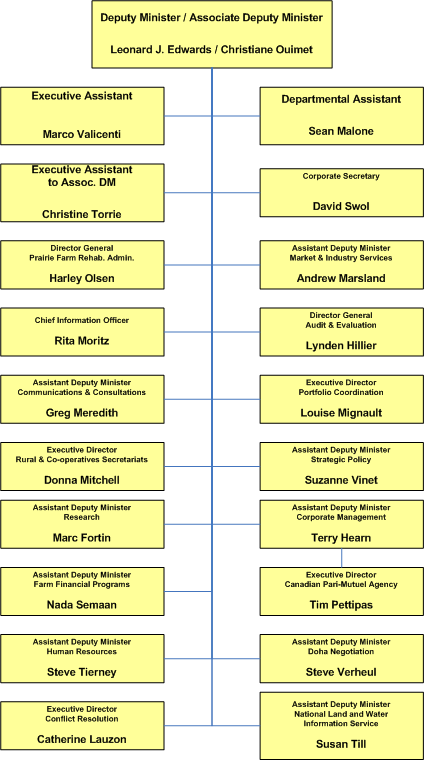
If your lobbying needs are much higher at the top, you would be wise to learn the organization chart of the Minister's office. To get a greater understanding of the Minister's office, click on the image here for an enlarged version:


While each department is different, learning from the example of Agriculture Canada's set up is a good means of getting a grasp on the understanding of Ministerial offices. In coming issues, other departments will be broken down as well.

_____________________

Mark Buzan is the owner of Action Strategies, a public affairs & marketing communications consultancy. You can subscribe now to his monthly public affairs newsletter by visiting www.action-strategies.ca and dropping down the newsletter menu.

Monday, October 09, 2006

Keeping Your Lobbying above Board

by Guy W. Giorno

A CEO who fails to file or who reports inaccurately is guilty of a federal offence. Heightening the stakes is the fact that failure to report and reporting inaccurately are strict liability offences, meaning that a CEO can be convicted even if he or she
did not intend to break the law.

Parliament’s approach to CEOs is much more severe than that of the provincial legislatures. In British Columbia, Nova Scotia and Ontario, a corporation’s employees are individually responsible to register as lobbyists.11 Even the Newfoundland and Labrador and Quebec laws, which place responsibility for filing on the corporate CEO, extend responsibility to the individual employees by providing that an employee who engages in unregistered lobbying is guilty of an offence.

Subject to the approval of Parliament, the new federal government intends to make the
federal laws even stricter. Proposed legislation would “ban success or contingency fee arrangements,” a practice currently permitted in provincial lobbying everywhere except Quebec. The New Democrats and Bloc Québécois are on record supporting this reform.

The new government also proposes to amend the federal Act to “Require ministers and
senior government officials to record their contacts with lobbyists.” This reform, long advocated by Democracy Watch, would be the most fundamental change to Canada’s lobbying laws since the federal statute was passed in 1988. Until now, the obligation to record and report on activity has rested solely on lobbyists and their employers. Those who are the subject of lobbying efforts have to date been free from any requirements of transparency or disclosure.

Democracy Watch has argued, with justification, that it is appropriate to ask those elected to public office and those employed to serve Canadians in government to account for their contacts with persons outside government. The new government agrees and, if Parliament concurs, both government officials and lobbyists will be required to report on contacts with each other.

Recent and pending changes to the federal law have implications for all jurisdictions. In past, the federal lobbyists registration statute has presaged legislative developments at the provincial level, at least in the provinces outside Quebec.

The Diminishing Importance of “Who You Know”

In addition to reforms to increase openness and transparency, the lobbying industry faces a fundamental transformation in how it does business. In the wake of controversy over “insiders” plying their trade, the old-fashioned model of access-based lobbying, still practised by some, faces combined pressure from public dissatisfaction, media scrutiny, and heightened enforcement.

Three areas in particular are now coming under increasing scrutiny: (1) the connection between political fundraising and lobbying; (2) the connection between lobbying and political advice/campaign support; and (3) the provision of services to government departments or agencies that one also happens to be lobbying.

Such activity has already attracted the attention of various advocates of reform. For example, the changes being championed by Democracy Watch include the following: Lobbyists should be required to disclose past or current work with
governments, political parties, or candidates for federal public office.

Lobbyists should be prohibited from serving in senior positions on campaigns of political parties or candidates (as is prohibited in Maryland and New Mexico).

Lobbyists should be prohibited from doing work with government departments they are lobbying, and from having business connections with anyone who does such work.

Among the Opposition parties, the NDP echoes the last of these recommendations. It
explains that “communications consultants should be obliged to decide whether they wish to be private lobbyists or public service confidantes. They should not be allowed to be both.

Meanwhile, following 214 days of hearings in the Toronto Computer Leasing Inquiry and
the Toronto External Contracts Inquiry, Madam Justice Denise Bellamy recommended that, “113. Professional lobbyists should not engage in any type of political fundraising for candidates or councillors they lobby, beyond making their own donations.

Amid the uncertainty of rules that continue to evolve and change, one thing is clear: the opportunities for old-fashioned, access-based lobbying are diminishing. This trend has obvious implications for companies that engage or employ lobbyists, but also for Canadians, who stand to benefit.

Guy W. Giorno is an attorney at law with Fasken Martineau

_____________________

Mark Buzan is the owner of Action Strategies, a public affairs & marketing communications consultancy. You can subscribe now to his monthly public affairs newsletter by visiting www.action-strategies.ca and dropping down the newsletter menu.

Monday, September 25, 2006

Writing Query Letters to Publish Articles

In the PR professional's handbag, is a tool known as the pitch letter. Very few people understand that the pitch letter is even more important than a press release when it comes to PR.

Very similar in purpose to a query, the pitch letter is meant to gain a media person's attention and make him or her ask for more. Unfortunately, there are plenty of books on how to write a killer query and virtually none on how to write a perfect pitch letter. Most PR people learn how to craft a pitch letter from trial and error (and advice when they can find it).

First things first - format: A pitch letter, like a query, should be limited to a single page. Limit your prose to three paragraphs and keep them clean, concise and direct. Use one inch margins and print it on letterhead or nice quality stationary. Make sure you have called ahead of time and gotten the correct spelling of the person's name and his or her title. If you aren't sure whether the person is a Mr. or a Ms., ask. If you don't know who you're looking for, ask. It is perfectly acceptable to say, "Could you tell me who books talent for the Leeza show? Do you know how far in advance they book a show?" It is better to play dumb and ask lots of questions than send your material to the wrong person. If you think the slush pile at a publishing house is ominous, it is nothing compared to a producer or editor's collection of daily pitches and press packets. A pitch letter can be sent alone or as a cover letter to your press release/press packet.

Content:
The first paragraph should introduce yourself and the subject. This is where you need a hook, but one that explains exactly what you have to offer, who you are, when the event is happening and where it will be. These are known as the five W's of journalism and should be included in every pitch letter and press release you write.

The second paragraph should explain why the producer or editor/reporter should have you on the show or include you in an article in their publication. For city and regional media, give them a local angle. It can showcase you as a local person, give a local example of a national incident or trend, or be related to the community. An example would be if you saw an article in the Wall Street Journal on how writing a book can be a quick road to success. Copy the article and attach it to a pitch letter that offers to give the reporter an inside look at what really happens to authors from a local source.

For national television, radio and print media, tie yourself to a national trend or incident. If you have a book coming out and want to get on the radio, tie the controversy of America's obsession with the Clinton "sex" scandal to the misinterpretation of romance books as "sex" books as a comment on our society. Remember that reporters are always looking for material that can be tied to a holiday, is timely or gives a new slant to a current trend or issue.

The third paragraph explains how you can be reached. Give them phone numbers and voice mail even if it is already printed on your letterhead. Always end your pitch letter by saying that you'll be contacting them and tell them when (such as next week, the beginning of the month or you can be specific and say a day.)
Above all, make sure that what you are pitching is what the media person needs. Don't pitch your book signing to the gardening editor or the financial editor, you'll only make enemies. Research is important. Look at back issues of a publication or watch/listen to a show before you pitch. Get to know what types of people they interview, what topics seem to repeated often and which journalist is the one reporting. If this seems like a lot of work, it is. But thorough investigation will pay off in better responses from the media. Their number one complaint is that they receive material which is not suited to their publication or show.

Media people need and want fresh ideas for their publications and shows. If you give them what they need, and make it easy for them, the more likely they will be to use your material and possibly interview you. Remember to think like a journalist on a deadline when you're writing a pitch letter.
_____________________

Mark Buzan is the owner of Action Strategies, a public affairs & marketing communications consultancy. You can subscribe now to his monthly PR & marketing tips newsletter by visiting www.actionstrategies.ca and dropping down the newsletter menu.
Six Future Trends Changing Marketing

By Mary Brown

1. Consumers Are the New Creative Directors

Brands that create a process of discovery drive passion and ownership of the brand. Consumers like being the creative director and feeling in control of shaping the products and brand. Born from consumers' desire to differentiate themselves from the mass market, this trend toward customization will continue to grow with the flexibility and efficiencies offered by technology at home and in manufacturing.

2. Cynicism Raises the Bar for Authenticity

With consumer cynicism about marketing at an all-time high, brands must cultivate authenticity on a level never demanded before. Consumers are smart, resourceful and savvy. If your brand doesn't deliver on all its promises, or fails to speak to a consumer's specific, personal needs, your brand will become irrelevant, or worse: a pariah.

Conveying brand messages via third parties, especially if they are a trusted, impartial source, will be better received. We'll see an increase in brands using the more transparent channels of public relations, sponsorship, niche interaction, word-of-mouth/buzz and blogs to deliver seemingly unbiased brand communications.

3. Multitasking and Info Overload: Don't Waste My Time


Consumers look to companies, media and marketers to provide information filters—tools to edit the mass amount of data available. As Robyn Waters, trends guru and former VP of Trend, Design and Product Development for Target, points out, "too much information without editing is toxic."

To effectively filter and communicate relevant data to a specific consumer, brands will need to be well versed in the art and science of interpreting, translating and delivering information. This requires cultural, ethnic, gender and generational expertise as well as sophisticated global knowledge of word associations and linguistics.

4.Humanisticn of Technology

Successful brands will "humanize" technology by delivering a brand experience where the technology is transparent to the consumer. Products, services and communications fashioned around innate human behavior, instead of the ideals of a programmer, will win consumers.

5. From Multi-Channel to Uni-Channel

Increasingly, consumers will be less aware of separate marketing channels. Instead, all experiences of brand communications will be perceived as one all-encompassing, 360-degree, 3-D channel. Brands can prepare now by investing in creating a consistent and integrated customer experience across today's communications channels.

6. Trends in Trending

With more than ever a largerproportionn of the population aging, marketing will need to find ways of catering to this ever important demographic.

_____________________
Mary Brown is president of Imago Creative. For more information, visit www.imagocreative.com.
_____________________

Mark Buzan is the owner of Action Strategies, a public affairs & marketing communications consultancy. You can subscribe now to his monthly PR & marketing tips newsletter by visiting www.actionstrategies.ca and dropping down the newsletter menu.

Sunday, September 24, 2006

It seems the times have changed the date of an election

Once again, the unstable nature of minority parliaments have shown themselves. I, as a result have to admit that perhaps the proverbial gun was jumped. A federal election in Canada now looks incredibly unlikely to occur. The opposition parties decided not to call the OM on his threat to call an election and the softwood lumber deal is going to go through. The question remains however, when will it be?

It seems the next likely date will be this Spring. Notwithstanding ''jumping the gun'', it is still wise to prepare your organization for the change in lobbying tactics you'll need when the writ is dropped. Have any thoughts? Let me know.

Friday, September 01, 2006

Contesting government buying decisions

Many entrepreneurs I come across in the Ottawa area have expressed an interest at one point or another in doing business with government. Many of them express frustration in the complicated process or have even accused the RFP issuers of already having a supplier in mind.

I want to touch on two subjects.

First, the latter is possible but it is not impossible to overcome. Well placed questions to RFP issuers are welcome. Just as in the sales process it is important to uncover the real motivations of a potential buyer's concerns; it is just as important to get to the heart of government purchasers concerns. For example, in a recent Communications RFSO available on the Merx system, I sent no less than 2 inquiries asking the purchaser to justify requirements I felt were unnecessary towards doing the job at hand.

I suppose the message here is that you should not be afraid to ask questions. You might just get them thinking!

Second, believe it or not, you can beat a lot of RFPs from ever making it to the Merx system by pricing your items under $25,000 and getting on the ''good list'' of decision makers. Believe me when I say it, if given the choice, many decision makers would prefer if they could just get on with the job. If you build relationships and market your company to the point of being top of mind, you could end up avoiding the headaches of frustrating challenges to RFP requirements.

Let me know your thoughts.
_____________________

Mark Buzan is the owner of Action Strategies, a public affairs & marketing communications consultancy. You can subscribe now to his monthly public affairs newsletter by visiting www.action-strategies.ca and dropping down the newsletter menu.